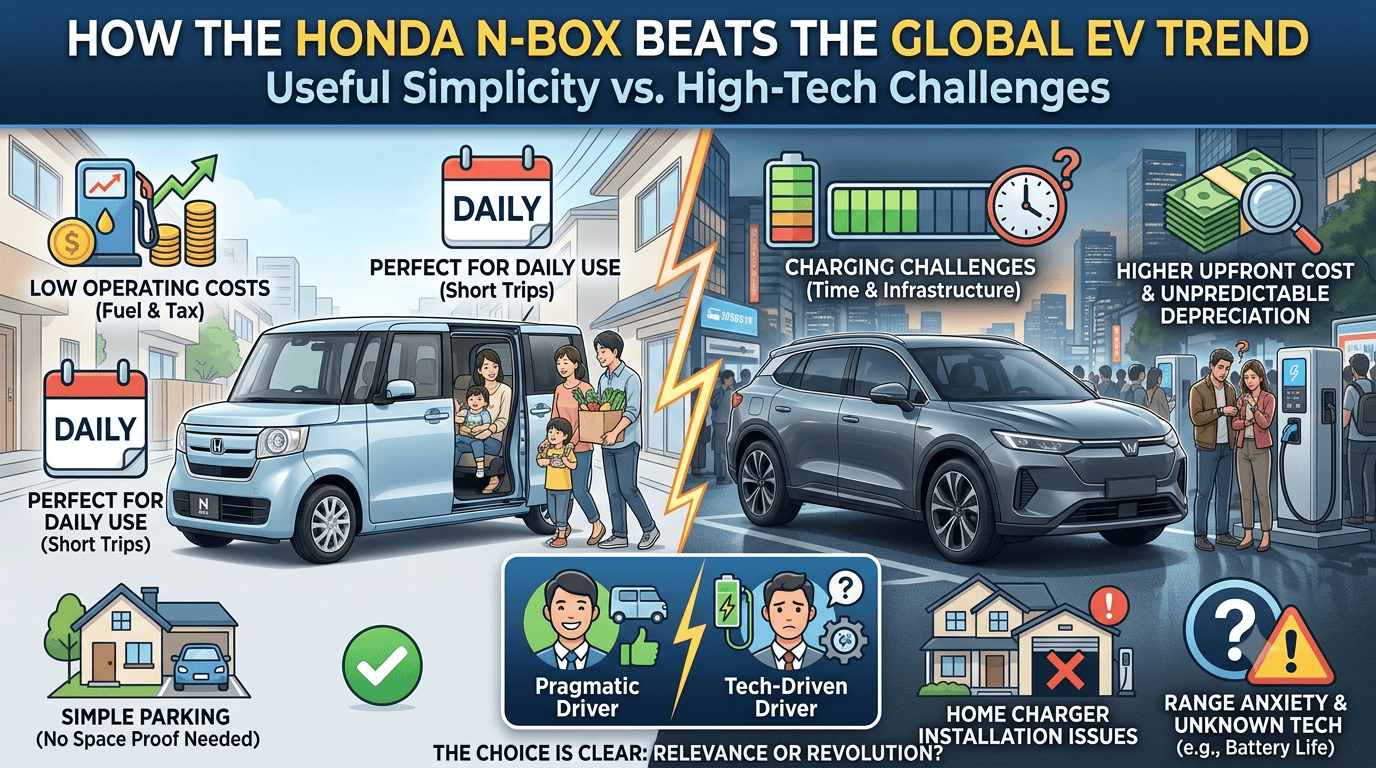
In an era dominated by electric cars, autonomous driving features, and giant sport utility vehicles (SUVs), an improbable hit is sweeping Japan. It is not a futuristic concept car or a hybrid gasoline-electric vehicle but rather a small, boxy vehicle with a 660-cube engine called the Honda N-Box.
According to the text, “In 2023 alone, Honda sold nearly 230,000 N-Boxes. That’s a stunning number for a single model and even more remarkable for the Japanese market.” To put that into perspective, there is not a car company today selling more than 200,000 of a single model. If that seems surreal, consider that the world’s largest automaker continues to make mistakes when it comes to small cars.
Why is it that this little-known automobile is topping the charts? What is the reason behind such an astonishing success? Why is this tiny car beating competitors with billion-dollar ideas, including the juggernaut Toyota?
These are all questions that will be answered as we delve into this topic and discover what makes the Japanese economy tick. We will reveal the ingenious design and engineering involved in this small box and analyze why the world’s largest automaker keeps making errors when it comes to small passenger cars.
1. The Anatomy of Pragmatism: The “Kei Car” Advantage
To comprehend the success of the N-Box, you first have to understand the Kei car (or keijidōsha) category. Born out of post-WWII government regulations to get the Japanese public driving affordably, Kei cars are bound by strict legal limits:
- Engine Displacement: Maximum of 660 cm³ (roughly the size of a large motorcycle engine).
- Dimensions: Rigidly restricted length and width boundaries to ensure an ultra-compact footprint.
In return for accepting these physical limits, owners are rewarded with massive tax breaks, cheaper registration fees, reduced highway tolls, and a vital legal perk: in many crowded urban zones, Kei car owners are exempt from having to prove they own a private parking space before buying the vehicle.
While many international brands see these restrictions as a compromise, Japanese consumers—highly valued for their relentless everyday practicality—see a perfect lifestyle fit. In densely populated hubs like Tokyo, Osaka, and Nagoya, heavy SUVs are cumbersome liabilities. The N-Box offers an elegant solution: microscopic on the outside, yet incredibly forgiving on the wallet.
2. A Tactic of Masterful Packaging
For decades, rival manufacturers treated Kei cars as “good enough” commuter appliances. They lacked premium features, basic sound deadening, and creative design. Honda entered the segment with a completely inverted mindset. They didn’t want to build a cheap runabout; they aimed to build the finest small vehicle an ordinary middle-class citizen could realistically own.
By utilizing a perfectly square, box-shaped chassis, Honda maximized internal volume to a degree that defies its outer dimensions. The car feels less like a compact sedan and more like a miniature luxury cargo van.
Honda obsessed over the tiny friction points of daily life. The side doors slide open to nearly 90 degrees, the step-in floor height is intentionally lowered so toddlers and elderly grandparents can enter effortlessly, and the rear seats fold completely flat to transform the back into a massive utility trunk. For a culture accustomed to maximizing tightly packed living spaces, the open, airy interior of the N-Box feels genuinely luxurious.
3. The Power of “Kaizen” vs. EV Anxiety
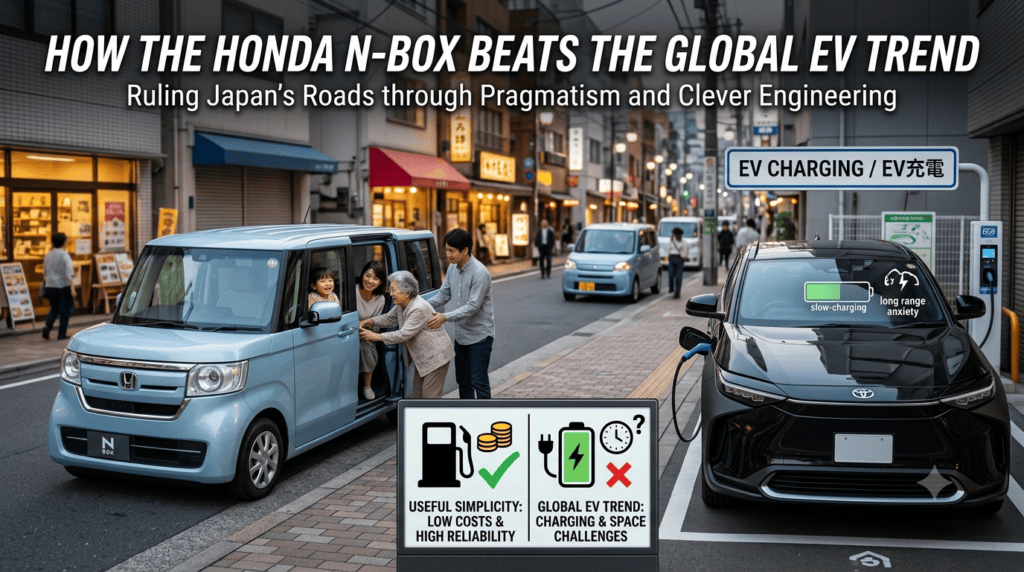
While global manufacturers are pouring billions into radical EV restylings and chasing short-lived tech trends, Honda relies on Kaizen—the Japanese philosophy of continuous, incremental improvement.
Instead of confusing buyers with jarring redesigns, Honda polishes the N-Box every year. A bit more sound insulation here, a slightly smoother Continuously Variable Transmission (CVT) fluid swap there, and gradual updates to its fuel-efficient 3-cylinder engine featuring Earth Dreams technology. Operating with an average fuel economy of 20 to 25 kilometers per liter (around 47–58 mpg), the N-Box directly protects the household budgets of urban commuters facing high gasoline prices.
This reliable execution highlights why the Japanese public remains deeply hesitant to swap over to full electric vehicles. In Japan:
- Space is a premium commodity; installing home charging stations is structurally impossible for apartment dwellers.
- The public charging infrastructure, while growing, lacks the density required to eliminate “range anxiety” during packed schedules.
- Unpredictable long-term costs, like expensive EV battery replacements, clash violently with a middle class that demands absolute dependability.
The N-Box requires no charging downtime, handles short city trips effortlessly, and runs on an internal combustion engine developed to a flawless level of reliability.
Premium Safety for the Everyday Driver
One of Honda’s most disruptive choices was trickling high-tier tech down to its cheapest model. The N-Box features the complete Honda Sensing safety suite as standard equipment:
- Automatic Emergency Braking
- Lane Departure Warning & Lane Keeping Assist
- Adaptive Cruise Control
- Surround-View Camera System
Features once reserved exclusively for premium sedans or midsize SUVs are packed right into this micro-car, making middle-class buyers feel deeply respected and protected.
4. Toyota’s Strategic Blindspot
The N-Box’s absolute dominance is also the result of a rare strategic misstep by Toyota. Focused heavily on scaling up global hybrid platforms and launching large-profile SUVs for the American and European markets, Toyota left its domestic Kei car development underfunded.
When modern Japanese consumers cross-shop Toyota’s micro-offerings against the Honda N-Box, the differences are immediately stark. Toyota’s entry-level small cars routinely offer less interior space, fewer standard safety features, and less refined cabins—all while carrying comparable price tags. By failing to appreciate the shifting standard of the urban middle class, Toyota left an open door. Honda walked right through it, capturing the loyalty of millions of local drivers.
5. A Blueprint for the Global Future?
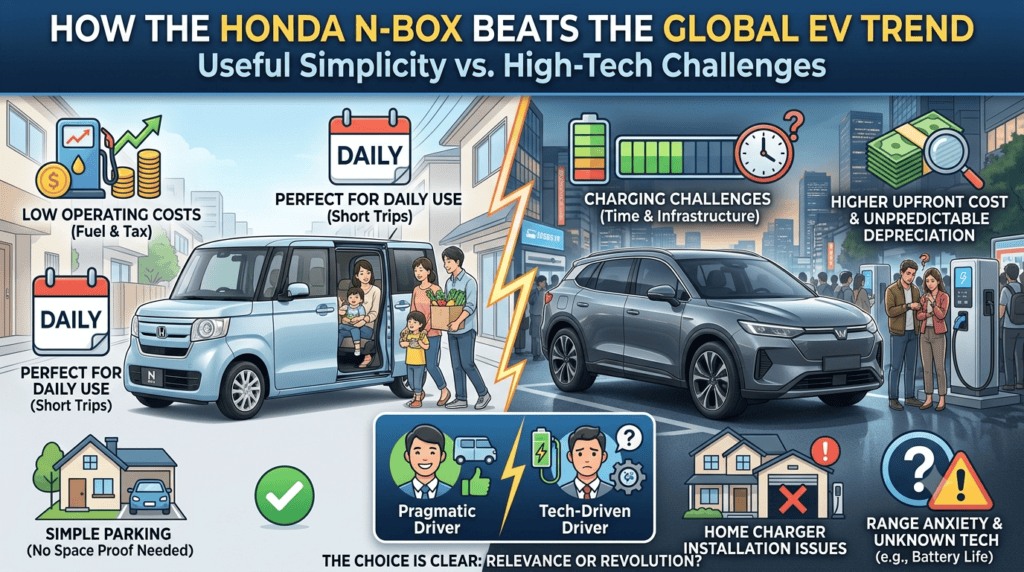
The message echoing out of the N-Box’s massive sales data is clear: useful simplicity is the ultimate luxury.
The auto industry’s obsession with heavier, faster, and more complex transport systems has left a gaping void for affordable, highly functional urban mobility. The lessons of the N-Box are already rippling outside of Japan. In tightly packed, narrow-street cities across Southeast Asia and Europe—from Bangkok and Seoul to Paris and Milan—the demand for micro-cars and ultra-compact vehicles is surging.
Ultimately, the Honda N-Box proves that a vehicle doesn’t need to be an aggressive status symbol to win the market. By placing the daily frustrations and genuine needs of ordinary people at the dead center of its engineering, this tiny box didn’t just become Japan’s favorite car—it became a vital reminder of what automotive design looks like when it truly puts the customer first.
Also read : The BYD Bombshell: How a Former Battery Workshop Is Out-Pacing Tesla and Re-Engineering the Auto Industry