There is a massive shift happening in the global automotive industry, and it centers around a name that many Western consumers still struggle to pronounce correctly: BYD (Build Your Dreams).
For years, the electric vehicle (EV) conversation was entirely dominated by Tesla and legacy automakers like Ford and General Motors. But almost overnight, BYD dropped a bombshell on the global market. They didn’t just catch up to the competition—they fundamentally changed the economics of building and selling a car.
By selling more fully electric vehicles globally than Tesla, and offering high-tech cars at prices that seem like typos, BYD is forcing the entire automotive world to answer a terrifying question: Can Western automakers actually compete, or are they hiding behind a tariff wall that will eventually crumble?
1. The $10,000 Disruption: More Than Just a Cheap Car
When Western consumers think of a $10,000 vehicle, they usually picture a heavily used, high-mileage compact car with a history of mechanical issues. BYD turned that notion on its head with models like the Seagull (known as the Dolphin Mini in some markets).
But the price tag is only half the story. The real disruption lies in what is included inside the box:
- Built-In Advanced Driver Assistance Systems (ADAS): Legacy brands like BMW, Mercedes-Benz, and Tesla frequently lock advanced driving features behind premium packages or software upgrades costing anywhere from $5,000 to $15,000. BYD includes its suite for free, standard across all price points.
- Standard Features as the Baseline: Features like adaptive cruise control, lane centering, and automated parking are treated as fundamental rights of the car buyer rather than luxury upgrades.
This aggressive pricing isn’t a temporary marketing gimmick or a VC-subsidized loss leader. It is the direct result of a structural foundation that BYD spent three decades building.
2. The Secret Weapon: Brutal Vertical Integration
To understand how BYD can profitably sell a high-tech car for the price of a used hatchback, you have to look past the assembly line. BYD is not fundamentally a car company; it is a technology and battery powerhouse that happens to build cars.
Founded in 1995 by chemist Wang Chuanfu with just $300,000 in seed capital, BYD began as a humble rechargeable battery workshop in Shenzhen, China. By reverse-engineering Japanese technology, Chuanfu focused on a singular goal: cutting manufacturing costs to the absolute bone without sacrificing baseline performance. By 2002, the company was the world’s leading supplier of lithium-ion batteries.
When BYD quietly acquired a failing Chinese automaker in 2003, they brought an entirely different manufacturing philosophy to the auto world: Extreme Vertical Integration.
During the pandemic-era supply chain crisis, legacy giants like Ford and GM were forced to halt entire factory lines because they couldn’t secure fingernail-sized microchips from overseas suppliers, losing billions of dollars. When BYD needed microchips, they simply called their internal chip-manufacturing division.
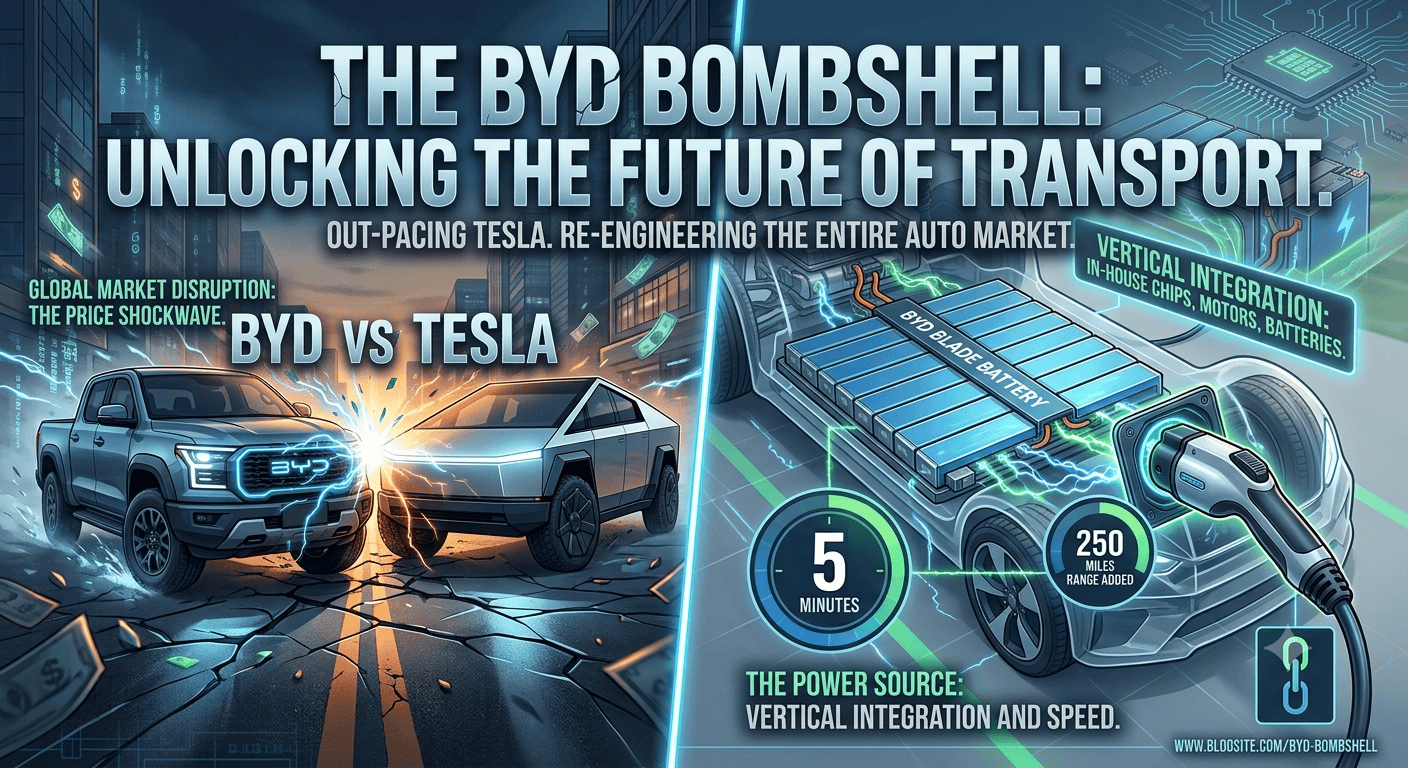
BYD manufactures its own batteries, electric motors, microchips, structural steel, glass, and even the seat foam. By eliminating the profit margins of external middlemen, they control their own timelines, quality control, and—most importantly—their cost structure. It’s a structural defense mechanism that famously drew a $232 million investment from Warren Buffett’s Berkshire Hathaway in 2008, an investment that ballooned to over $8 billion by 2021.
3. The Blade Battery: A Paradigm Shift in EV Safety
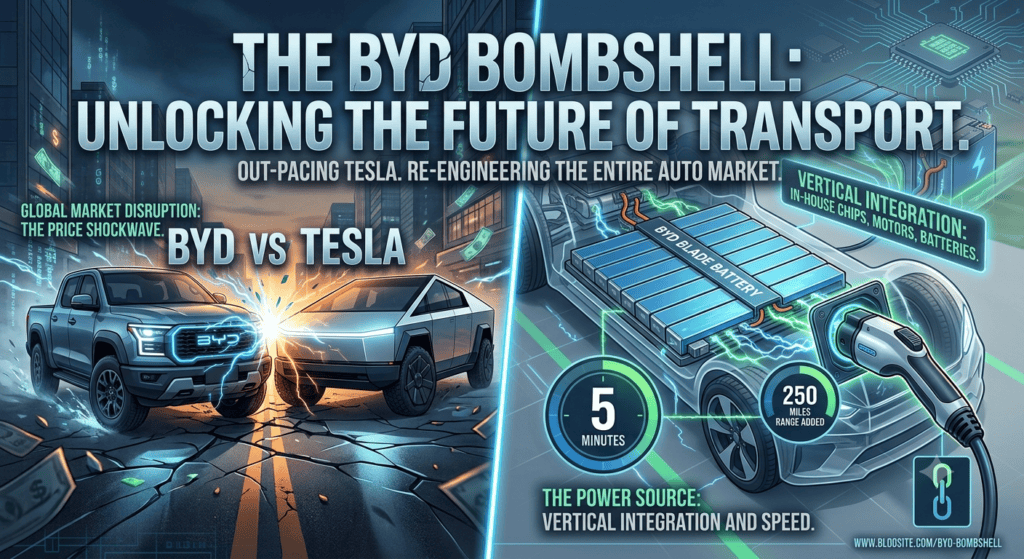
The crowning achievement of BYD’s internal supply chain is the Blade Battery, introduced in 2020.
Traditional EV battery packs are incredibly complex. They pack individual battery cells into modules, which are then packed into larger arrays, which are finally housed inside the main battery casing. This multi-layered “box within a box” approach wastes roughly 50% of the physical space inside the pack and adds numerous points of potential electrical failure.
BYD threw out the modules entirely. The Blade Battery uses long, flat, singular cells that slide directly into the pack layout like blades in a drawer. This design choice optimizes structural space by 50% while vastly simplifying the assembly process.
The Nail Penetration Test
Beyond packaging efficiency, the Blade Battery solved a massive psychological barrier for potential EV buyers: thermal runaway (battery fires).
During the industry-standard Nail Penetration Test—which simulates a catastrophic high-impact crash by driving a steel nail directly through a fully charged battery cell—most traditional lithium-ion batteries experience rapid temperature spikes, emit toxic smoke, or erupt into violent flames.
When subjected to the same test, the BYD Blade Battery remained completely stable. The surface temperature barely budged, displaying no smoke and zero fire. BYD treats this ultra-safe battery architecture as its core foundational tech, inserting it into everything from their entry-level $10,000 hatchbacks to their high-performance luxury sports cars.
4. The 2025/2026 Numbers That Made Detroit Uncomfortable
The financial chasm between BYD’s operation and Western EV initiatives is widening every single quarter. Looking closely at recent industry data reveals the true scale of the shift:
- Profits vs. Losses: In 2024, BYD delivered 3.4 million total plug-in vehicles (including 1.76 million pure EVs), netting a staggering $5.6 billion in pure profit. In stark contrast, Ford’s specialized EV division lost roughly $5 billion in 2024 alone, while GM burned through billions in retooling costs.
- Volume Discrepancy: In the first quarter of 2025, BYD independently sold 416,000 pure electric vehicles. To put that in perspective, the entire United States EV market—combining every single delivery from Tesla, Ford, GM, Rivian, Lucid, Hyundai, and Kia—totaled just 350,000 vehicles in that same three-month window.
Breaking the Charging Barrier
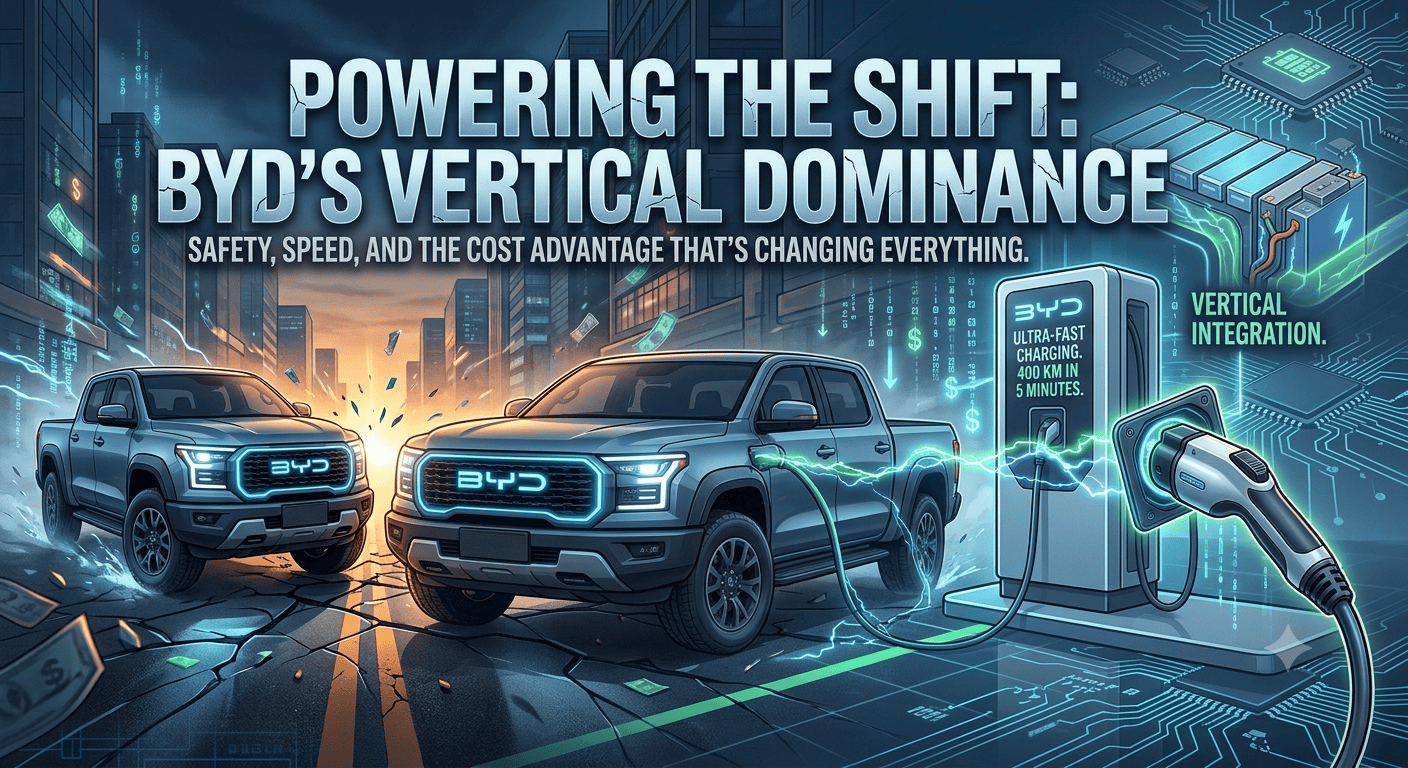
Compounding their volume advantage, BYD introduced a 1,000-volt, 1,000-amp charging platform capable of delivering 400 kilometers (roughly 250 miles) of range in just 5 minutes.
Range anxiety is quickly being replaced by “charge-time anxiety.” By reducing the charging experience down to the time it takes to buy a bottle of water at a rest stop, BYD has effectively eliminated the final psychological hurdle holding back mainstream EV adoption.
To support this infrastructure, BYD didn’t wait for public utilities; they laid out plans to build 4,000 proprietary ultra-fast charging stations in a single year across China alone—nearly rivaling the entire established Tesla Supercharger footprint in the United States at the time.
5. Scaling the Tariff Walls: The Global Footprint
American and European media frequently point out that BYD does not currently sell passenger cars directly inside the United States, giving the impression that Western markets are safe. However, BYD is already operating inside more than 70 countries with a highly calculated, patient expansion strategy.
When the European Union slapped tariffs as high as 35% on Chinese-made EVs in late 2024, BYD didn’t retreat. They immediately broke ground on an automotive assembly plant in Hungary, effectively bypassing the tariff system by manufacturing locally within EU borders.
A similar playbook is unfolding across the Western Hemisphere:
- Latin American Dominance: In Mexico, the BYD Shark (a plug-in hybrid truck) rapidly became the country’s bestselling pickup truck overall—not just the bestselling EV truck.
- The Backdoor to Detroit: BYD is aggressively building out manufacturing facilities in Brazil and Mexico. An active production facility in Mexico raises crucial economic questions regarding North American trade agreements (USMCA). If a car is built using localized North American components, it could potentially cross into the U.S. market without triggering the 100% tariff wall established against Chinese imports.
- The Invisible Supply Chain: Even if American consumers aren’t buying BYD cars, they are likely driving vehicles built with their help. BYD currently runs an active manufacturing joint venture with Toyota, supplies battery packs directly to Ford, and collaborates heavily with Stellantis on global platforms.
6. What This Means for Your Next Car Purchase
You do not need to buy a BYD vehicle to feel the direct economic impact of their market pressure. The “BYD Effect” is already putting cash back into consumer wallets globally.
The aggressive price-cutting campaigns launched by Tesla, which saw the base price of the Model 3 drop significantly over a multi-year window, were direct competitive reactions to BYD’s global pricing structures. Similarly, Ford’s deep cuts to the Mustang Mach-E and GM’s push to launch the Equinox EV at a more accessible $35,000 baseline were forced moves. Western brands must either optimize their unit economics or concede massive chunks of market share.
The ultimate legacy of this hyper-competition won’t be the downfall of traditional brands, but the acceleration of the entire industry. When a company proves that a safe, high-range, feature-complete vehicle can be built efficiently, every other engineering department on Earth is forced to innovate faster.
The tariff walls have bought Western legacy automakers crucial time to retool their factories, rethink their supply chains, and eliminate internal bureaucratic inefficiencies. The real question is whether they will use this breathing room to genuinely close the technology gap—or simply delay the inevitable.
Read more : Best Windows Laptop For Machine Learning