AI Beats Humans in 83% of Real Jobs — GPT-5.4 Shock Report
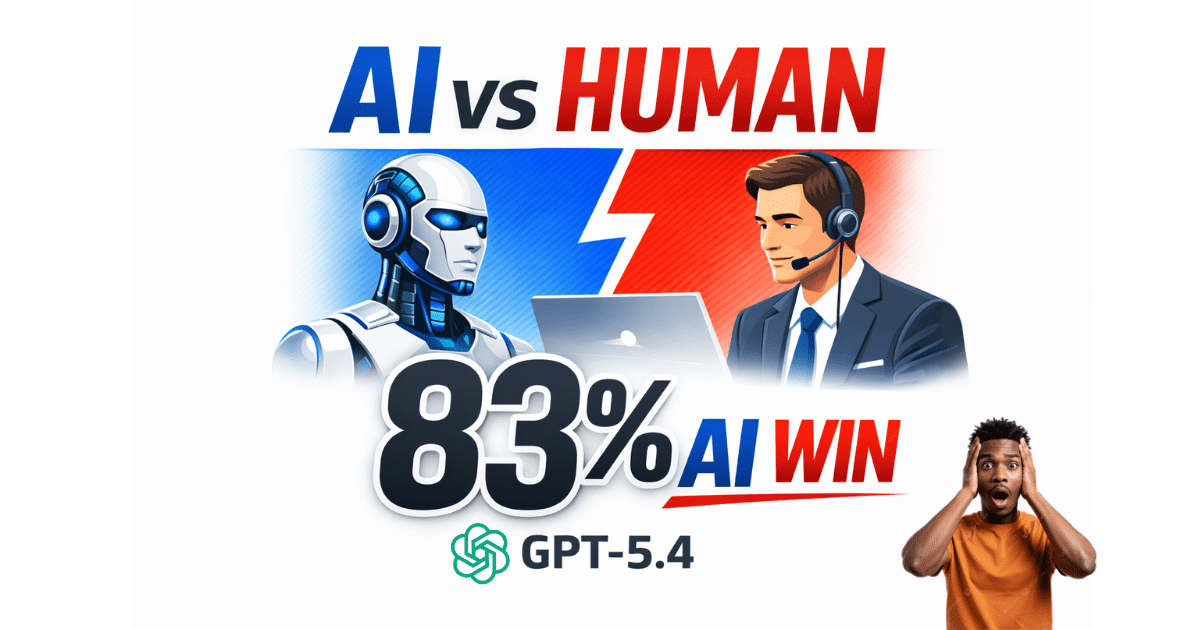
The artificial intelligence race has just reached a stunning milestone. According to new benchmark results, AI can now outperform human professionals in 83% of real-world knowledge-work tasks. The breakthrough comes from GPT‑5.4, the latest advanced model developed by OpenAI.
This shocking result is based on the GDPval benchmark, a test designed to measure how well AI systems perform professional work across multiple industries. In this evaluation, GPT-5.4 matched or exceeded human performance in 83% of comparisons, a dramatic improvement compared with previous models that achieved around 70.9% performance.
For the first time, AI is showing the ability to handle complex real-world tasks across dozens of professions, signaling a major turning point in the evolution of artificial intelligence.
What Is GPT-5.4?
GPT-5.4 is the newest frontier AI model released by OpenAI for ChatGPT, developer APIs, and AI agents. It combines several advanced technologies into a single system capable of performing professional knowledge work.
Unlike earlier AI models that mainly generated text, GPT-5.4 can now:
- Solve complex reasoning problems
- Write and debug production-level code
- Analyze documents and spreadsheets
- Conduct deep web research
- Work across tools and software environments
According to OpenAI, GPT-5.4 integrates the coding capabilities of GPT-5.3-Codex while improving reasoning, research, and workflow automation across real professional tasks.
Source: OpenAI
The Benchmark Result That Shocked the Tech World
The headline statistic — AI beats humans in 83% of jobs — comes from the GDPval benchmark, which evaluates AI performance on real professional tasks across 44 occupations.
These tasks simulate common workplace activities such as:
- Writing reports
- Conducting research
- Analyzing data
- Creating presentations
- Solving technical problems
GPT Model Benchmark Comparison
| AI Model | GDPval Performance |
|---|---|
| GPT-5.4 | 83.0% |
| GPT-5.3-Codex | 70.9% |
| GPT-5.2 | 70.9% |
This means the newest model represents a major leap in AI capability, pushing performance far beyond earlier systems.
Source: OpenAI
Why GPT-5.4 Is So Powerful
Several technological breakthroughs allow GPT-5.4 to outperform previous AI models.
1. Advanced Reasoning
GPT-5.4 significantly improves logical reasoning, enabling the AI to analyze complex problems step-by-step before producing answers. This leads to more accurate results in research, business analysis, and technical tasks.
2. Industry-Leading Coding Ability
The model incorporates the advanced coding capabilities of GPT-5.3-Codex, allowing developers to use AI for:
- Writing software
- Debugging code
- Generating scripts
- Automating programming tasks
This makes GPT-5.4 one of the most powerful coding assistants available today.
3. Massive 1 Million Token Context Window
Another breakthrough feature is GPT-5.4’s 1 million token context window, which allows the model to process extremely large amounts of information at once.
This enables AI to analyze:
- Entire documents
- Large datasets
- Full codebases
- Long research reports
Such capability dramatically expands the scale of tasks AI can handle.
4. AI Agents That Can Use Computers
GPT-5.4 also introduces advanced computer-use capabilities, enabling AI agents to operate software and perform workflows across applications.
This allows the model to:
- Search for tools automatically
- Execute multi-step tasks
- Interact with software environments
- Manage complex workflows
For developers and businesses, this means AI can function closer to a digital worker capable of completing real tasks.
AI Is Becoming a Digital Knowledge Worker
With these capabilities combined, GPT-5.4 is moving artificial intelligence closer to what experts call a digital knowledge worker.
Instead of answering a single prompt, the AI can now:
- Understand a complex objective
- Plan a strategy
- Use digital tools
- Execute tasks
- Deliver a finished output
This workflow mirrors how many professionals perform their daily jobs.
Industries that could benefit from such technology include:
- Software development
- Marketing and content creation
- Research and data analysis
- Business consulting
- Customer support
Does This Mean AI Will Replace Human Jobs?
The statistic that AI beats humans in 83% of tasks has sparked global discussion about the future of work.
However, most experts emphasize that AI is more likely to augment human workers rather than fully replace them.
While AI excels at processing data and automating repetitive tasks, humans still dominate areas such as:
- Creativity
- Strategic decision-making
- Emotional intelligence
- Leadership and communication
The most likely future is a human-AI collaboration model, where professionals use AI tools to dramatically increase productivity.
Why This AI Breakthrough Matters
The GPT-5.4 benchmark results highlight how quickly artificial intelligence is evolving.
Just a few years ago, AI struggled with complex reasoning tasks. Today, advanced models can perform professional work across dozens of industries.
The next generation of AI systems is expected to deliver even more powerful capabilities, including:
- Autonomous AI agents
- Advanced reasoning systems
- Fully automated digital workflows
- Deep integration with software ecosystems
These advancements could transform how work is performed across the global digital economy.
Here’s a short, punchy table section you can add to your article. It’s designed to be scannable and engaging, which helps with reader retention and platforms like Google Discover.
| Skill | Why It Matters |
|---|---|
| AI Prompting | Knowing how to instruct AI tools can multiply productivity and unlock powerful results. |
| Critical Thinking | Humans must verify AI outputs, detect mistakes, and make strategic decisions. |
| Creativity | Original ideas and innovation remain a uniquely human advantage in the AI age. |
| AI Tool Mastery | Understanding how to use modern AI platforms gives professionals a massive edge. |
| Data Literacy | Interpreting data and insights is becoming essential across almost every industry. |
| Adaptability | Technology evolves rapidly, so the ability to learn new tools quickly is crucial. |
| Human Communication | Leadership, persuasion, and emotional intelligence are skills AI cannot easily replicate. |
Bottom line: The future belongs to people who combine human intelligence with AI capabilities rather than competing against them.
Final Verdict
The headline result that AI beats humans in 83% of real jobs represents a major milestone in the development of artificial intelligence.
With the launch of GPT-5.4, AI systems are evolving from simple chatbots into powerful digital assistants capable of completing complex professional tasks.
While the long-term impact on jobs remains uncertain, one thing is clear: artificial intelligence is advancing at an unprecedented pace — and the boundary between human expertise and machine intelligence is becoming thinner than ever.
Related AI Topic (Explore More)
- GPT-5.4 vs GPT-5.2: What’s New in OpenAI’s Latest AI Model
- What Is GPT-5.4? Features, Capabilities, and Real-World Use Cases
- AI vs Humans: Which Jobs Could Artificial Intelligence Replace First
- Top 10 Jobs Artificial Intelligence Will Transform by 2030
- How AI Agents Are Changing the Future of Work
- GPT-5.4 Benchmark Explained: Understanding the GDPval Test
- Best AI Coding Tools Compared: GPT-5.4 vs Copilot vs Claude