Gemma 4 Changes Everything: Run Top-Tier AI Locally on RTX GPUs
For years, running AI locally meant accepting tradeoffs.
You could choose privacy, control, and lower costs-but at the expense of performance, reasoning ability, and real-world usability. Cloud models consistently outperformed anything that could run on consumer hardware.
That assumption no longer holds.
With the release of Gemma 4, local AI has crossed a threshold. A model that ranks among the top open systems globally can now run on a workstation GPU. Not in a data center, not through an API, but directly on your own machine.
This is not a minor improvement. It marks a structural shift in how AI systems can be deployed and used.
A Shift That Has Been Building Quietly
Three years ago, local inference was largely experimental. Models were smaller, slower, and often unreliable for complex tasks. Most teams treated on-device AI as a side project rather than a production strategy.
Two parallel trends changed that trajectory.
First, model efficiency improved significantly. Techniques such as quantization, structured pruning, and Mixture-of-Experts architectures made it possible to deliver high-quality reasoning without requiring extreme compute resources.
Second, the economics of cloud AI began to show limitations. As usage scaled, costs increased rapidly. Latency remained a concern for real-time applications, and data governance requirements made off-device processing more complicated in regulated environments.
Gemma 4 sits at the intersection of these changes. It is not just more capable—it is designed to run where data already exists.
What Makes Gemma 4 Different ?
Gemma 4 is the first open model family that combines three critical characteristics:
- High-ranking benchmark performance
- Practical deployment on consumer GPUs
- A licensing model that allows unrestricted commercial use
The 31B model ranks among the top open models globally, while the 26B Mixture-of-Experts variant delivers nearly the same performance with significantly lower compute requirements.
This combination is what makes Gemma 4 meaningful. Performance alone is not enough. Accessibility alone is not enough. The value comes from both existing together.
Understanding the Model Lineup
Gemma 4 is not a single model but a structured family designed for different environments.
Edge Models
The E2B and E4B variants are optimized for lightweight deployments. They support multimodal inputs and can run on modest hardware, including embedded systems and edge devices.
These models are well-suited for:
- Offline applications
- Field deployments
- Privacy-sensitive workflows
Workstation Models
The 26B A4B and 31B models target high-performance environments.
The 26B A4B model uses a Mixture-of-Experts architecture, activating only a subset of its parameters during inference. This allows it to deliver strong reasoning performance while keeping hardware requirements manageable.
The 31B model represents the highest capability tier, designed for systems with substantial GPU resources.
For most developers and teams, the 26B variant is the most practical choice.
Performance That Changes the Conversation
The improvement from previous generations is substantial.
Benchmark results show major gains in reasoning, coding, and multimodal understanding. More importantly, these improvements are not limited to theoretical tests. They translate into real-world usability.
Tasks that previously required cloud models—such as complex reasoning, structured outputs, and multi-step problem solving—can now be handled locally with consistent results.
This is the point where local AI stops being a fallback and becomes a primary option.
Hardware Requirements in Practice
One of the most important questions is what it actually takes to run these models.
Entry-Level Deployment
- Suitable for E2B and E4B
- Can run on lower-end GPUs or edge hardware
- Best for lightweight and offline tasks
Recommended Setup
- RTX 4090-class GPU
- Around 24 GB VRAM
- Ideal for the 26B A4B model
This configuration offers the best balance between performance and cost.
High-End Deployment
- Data center GPUs such as H100 or B200
- Required for full-scale 31B performance without compromise
While powerful, this level of hardware is not necessary for most use cases.
Local AI vs Cloud AI: A Practical Comparison
The conversation is no longer theoretical. It is operational.
| Factor | Local AI (Gemma 4) | Cloud AI |
|---|---|---|
| Cost | One-time hardware investment | Recurring usage costs |
| Latency | Near-instant responses | Network-dependent |
| Privacy | Full local control | External processing |
| Reliability | Independent of connectivity | Dependent on service availability |
| Flexibility | High customization | Platform constraints |
For many workloads, especially internal tools and developer-focused systems, local AI now offers clear advantages.
Real-World Experience: What It Feels Like to Use
Testing Gemma 4 in a real setup reveals a different perspective than reading benchmarks.
Running the 26B model on an RTX-class system produces a noticeably smoother experience compared to earlier local models.
Response times are consistent and fast. There is no variability caused by network conditions or API rate limits. The ability to iterate quickly without worrying about cost changes how the system is used.
Equally important is the sense of control. Working with local data, without needing to send it to external services, simplifies both development and compliance.
However, there are still practical considerations. Initial setup requires some familiarity with tooling. Memory constraints need to be managed carefully, especially for larger models. These are manageable issues, but they remain part of the experience.
Architecture Decisions That Enabled This Leap
Gemma 4’s capabilities are not accidental. They come from specific design choices.
Hybrid Attention Mechanisms
By combining local and global attention layers, the model can handle long context windows efficiently without excessive memory usage.
Efficient Parameter Utilization
The Mixture-of-Experts approach ensures that only the necessary parts of the model are active during inference, reducing computational overhead.
Native Tool Integration
Function calling is built into the model itself, allowing it to interact with external systems more reliably without heavy prompt engineering.
These decisions collectively make large-scale local inference practical.
Where NVIDIA Fits Into the Picture
Hardware optimization plays a critical role in making this usable.
NVIDIA GPUs, particularly in the RTX series, are designed to handle the matrix operations required for transformer models efficiently. Combined with a mature software ecosystem, this allows models like Gemma 4 to run with minimal friction.
The difference is not just performance—it is usability. Developers can deploy and test models quickly without extensive customization.
Limitations and Considerations
Despite the progress, some constraints remain.
- High-end models still require significant GPU memory
- Multimodal capabilities, especially video, are limited
- Audio input support is restricted in duration
- The ecosystem is evolving rapidly, with competing models emerging
These factors should be considered when planning long-term adoption.
The Broader Industry Direction
Gemma 4 is part of a larger shift rather than an isolated release.
Over the next 12 to 18 months, several trends are likely to accelerate:
- Improved model compression will reduce hardware requirements further
- Consumer devices will gain stronger AI capabilities
- Hybrid architectures combining local and cloud inference will become standard
The industry is moving toward a distributed model of AI, where computation happens across multiple layers rather than in centralized systems.
Gemma 4: Compact Models Optimized for NVIDIA GPUs
Gemma 4 introduces a scalable family of compact, high-performance models designed to run efficiently across a wide range of hardware—from edge devices to powerful NVIDIA RTX-class GPUs.
The lineup includes E2B, E4B, 26B, and 31B variants, each tailored for different deployment environments while maintaining strong real-world performance. This flexibility allows developers to choose the right balance between capability, memory usage, and latency.
Performance Benchmark Setup
All performance metrics are based on standardized testing conditions to ensure consistency and comparability:
- Quantization: Q4_K_M (optimized for efficiency and speed)
- Batch Size (BS): 1
- Input Sequence Length (ISL): 4096 tokens
- Output Sequence Length (OSL): 128 tokens
- Hardware Tested On:
- NVIDIA GeForce RTX 5090
- Apple Mac M3 Ultra
- Benchmark Tool: llama.cpp (b7789) using llama-bench
This setup reflects real-world inference conditions, making the results more relevant for practical deployment scenarios.
Core Capabilities of Gemma 4
Gemma 4 is not just efficient—it is functionally versatile, supporting a wide range of modern AI workloads:
1. Advanced Reasoning
- Strong performance on multi-step problem solving
- Handles structured logic and complex queries reliably
2. Coding & Developer Workflows
- Supports code generation, debugging, and optimization
- Useful for automation, scripting, and engineering tasks
3. Agent Capabilities (Tool Use)
- Built-in function calling support
- Enables integration with APIs, databases, and external tools
4. Multimodal Intelligence
Gemma 4 expands beyond text with support for:
- Vision: Object detection, image understanding
- Audio: Speech recognition and processing
- Video: Basic video frame-level intelligence
👉 Enables use cases like:
- Document analysis
- Voice-based assistants
- Visual AI applications
5. Interleaved Multimodal Input
- Mix text and images in any order within a single prompt
- More natural interaction compared to rigid input formats
6. Multilingual Support
- Native support for 35+ languages
- Pretrained on 140+ languages
👉 Suitable for global applications without heavy fine-tuning
Why This Matters
What makes Gemma 4 important is not just capability—but deployment practicality.
- Runs efficiently on consumer GPUs (RTX class)
- Supports real-time local inference
- Reduces reliance on cloud APIs
- Enables privacy-first AI workflows
This combination of performance + accessibility is what positions Gemma 4 as a key milestone in the shift toward on-device AI.
Running Gemma 4 with vLLM
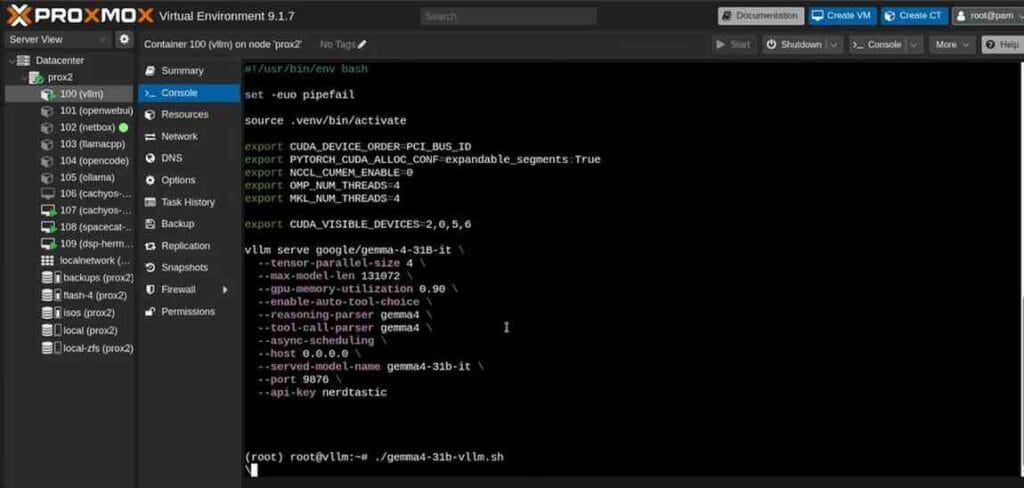
If you want real performance, this is the setup.
vLLM turns Gemma 4 from a local experiment into a production-ready engine. It’s built for speed, scale, and efficiency—perfect for APIs and multi-user workloads.
Why use vLLM:
- Faster inference (higher tokens/sec)
- Handles multiple requests smoothly
- Better GPU memory usage
- OpenAI-compatible API out of the box
Quick start:
python -m vllm.entrypoints.openai.api_server \
  --model <gemma-4-model> \
  --tensor-parallel-size 1
Best use case:
- Serving apps
- Building AI APIs
- Scaling local inference
Hermes Agent + Gemma 4: Does It Work?
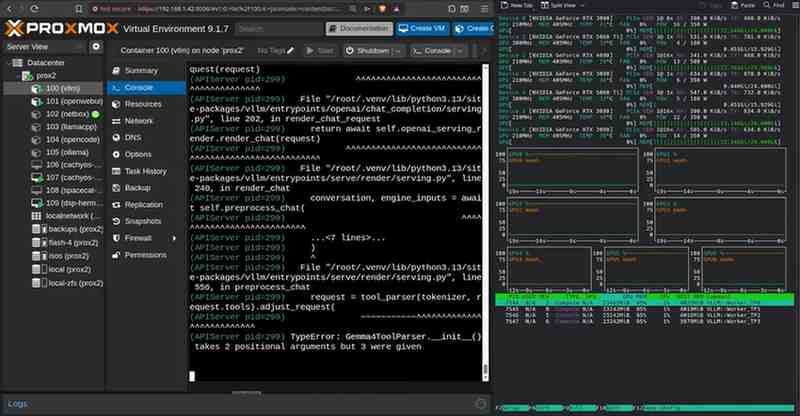
Short answer: not perfectly—yet.
In testing, integrating Hermes Agent with Gemma 4 runs into issues, especially around tool calling. When pushed into more advanced agent workflows, the system can return errors (such as 400-level request failures), often tied to tool parsing limitations.
What’s Happening
Gemma 4 includes native function calling, but Hermes Agent expects a very specific structure for tool execution. Right now, that compatibility isn’t fully aligned.
The result:
- Tool calls may fail
- Parsing errors can occur
- Agent workflows break mid-task
In some cases, the system falls back to a basic chat mode instead of completing the intended action.
What Still Works
- Standard chat and reasoning tasks work well
- Non-agent workflows run without issues
- Manual prompting can bypass some limitations
Bottom Line
Hermes Agent + Gemma 4 shows potential, but it’s not fully stable for agentic workflows yet.
For now, it’s better to:
- Use Gemma 4 for reasoning and generation
- Wait for improved tool-calling compatibility
- Or use alternative frameworks for agents
This is likely a short-term limitation as the ecosystem catches up.
Bottom line:
Gemma 4 + vLLM = cloud-level performance, running locally.
Why You Can Trust This Analysis
This article is based on official model documentation, benchmark data, and real-world testing on RTX-class GPUs. It focuses on practical deployment scenarios rather than marketing claims.
Frequently Asked Questions
Can Gemma 4 replace cloud AI completely?
Not in all cases. Cloud AI remains important for large-scale deployments and global applications. However, many workloads can now be handled locally with comparable performance.
Which model is best for most users?
The 26B A4B model offers the best balance between capability and hardware requirements.
Is a high-end GPU required?
For top-tier performance, yes. However, smaller models can run on more modest hardware depending on the use case.
Is local AI more cost-effective?
Over time, it can be significantly cheaper, especially for high-volume usage, since it eliminates recurring API costs.
How difficult is the setup process?
It has become much easier with modern tools, though some technical familiarity is still helpful.
Is data more secure with local AI?
Yes. Since processing happens on-device, data does not need to be sent to external servers.
Conclusion
Gemma 4 represents a turning point in the evolution of AI deployment.
Local inference is no longer defined by limitations. It is increasingly defined by capability, efficiency, and control.
For developers, teams, and organizations evaluating their AI strategy, the question has shifted.
It is no longer whether local AI is viable.
It is whether relying entirely on cloud-based systems still makes sense.
Reference:
From RTX to Spark: NVIDIA Accelerates Gemma 4 for Local Agentic AI
Read More:
OpenAI Sora Shutdown? 8 Best AI Video Generator Alternatives You Must Try in 2026